
Understanding how a kamado works may seem daunting during the first uses. However, once its operating principles are mastered, it becomes one of the most versatile and high-performing cooking equipment on the market.
Heir to a cooking tradition that is thousands of years old, the Kamado QUATRO today combines the best of charcoal cooking with modern technology. Thanks to its high-density ceramic design, it allows for grilling, smoking, roasting, low-temperature cooking, and even making pizzas worthy of a traditional wood-fired oven.
Whether you are a beginner or a barbecue enthusiast, this comprehensive guide will accompany you in discovering the Kamado QUATRO. You will learn how a kamado works, how to light it correctly, master temperatures, succeed in your direct and indirect cooking, perform long-duration smoking, and maintain your device to keep its performance for many years.
Through our usage tips, practical charts, temperature settings, and detailed FAQ, you will have all the information necessary to fully exploit the potential of your Kamado QUATRO and succeed in each of your cooks.
In this complete guide to the Kamado QUATRO COEO, discover:
- The operation of a kamado
- The features of the QUATRO
- The settings for air inlets
- The recommended cooking temperatures
- Smoking and low-temperature cooking
- Cooking pizzas
- Maintenance tips
- Answers to frequently asked questions
What is a Kamado?
The kamado is a charcoal cooking appliance inspired by traditional Japanese ovens used for several millennia. Its design is based on a refractory ceramic cooking chamber capable of accumulating and then evenly distributing heat.
Unlike a traditional barbecue, a kamado functions as a true multifunction outdoor oven. Thanks to the combination of ceramic, controlled air circulation, and excellent thermal insulation, it allows for grilling, smoking, roasting, low-temperature cooking, as well as making pizzas at very high temperatures.
The Kamado QUATRO COEO retains the fundamental principles of the traditional kamado while adopting a modern design with a characteristic conical shape. This geometry promotes optimal circulation of heat and smoke in the cooking chamber while providing a unique visual identity to the COEO range.
Les particularités du Kamado QUATRO
The Kamado QUATRO is immediately distinguished by its unique design. Unlike many traditional oval-shaped kamados, the QUATRO adopts a conical silhouette that promotes a more efficient natural circulation of heat and smoke within the cooking chamber. This particular geometry helps maintain a consistent temperature across the entire cooking surface and improves thermal stability during long preparations.
The high-density ceramic used in the manufacture of the Kamado QUATRO COEO is another determining factor. This refractory ceramic accumulates thermal energy and then gradually releases it throughout the cooking process. This thermal storage capacity allows for reduced charcoal consumption while providing remarkable temperature stability.
The adjustable ventilation system of the Kamado QUATRO COEO also plays a crucial role in cooking performance. The low air inlets and the upper chimney allow for precise adjustment of oxygen circulation and thus the intensity of charcoal combustion. This particularly fine control of air flows explains why the QUATRO can operate at 80°C for smoking as well as over 450°C for pizza cooking.
How does a Kamado barbecue work?
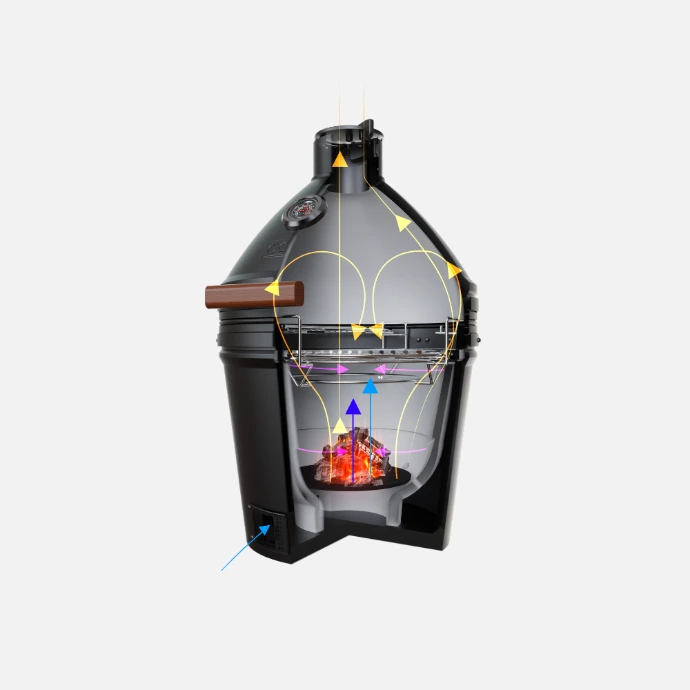
The operation of a Kamado QUATRO is based on a particularly efficient natural convection principle. Fresh air enters the barbecue through the lower opening, passes through the firebox where the charcoal burns, and then gradually warms up before naturally rising into the cooking chamber (lid). This hot air circulates around the food before being expelled through the upper chimney (top vent).
This constant airflow is the heart of the kamado barbecue's operation. The larger the openings, the more oxygen is supplied, and the faster the temperature rises. Conversely, when the vents are reduced, the charcoal burns more slowly, and the kamado maintains lower temperatures particularly suited for smoking and low-temperature cooking.
The combination of this natural convection with refractory ceramic allows the Kamado QUATRO COEO to retain stable heat for several hours with minimal intervention.
Materials and thermal insulation
High-density ceramic is the true signature of the Kamado QUATRO. Thanks to its refractory properties, it accumulates a large amount of heat and then gradually releases it throughout the cooking chamber. This phenomenon explains why temperatures remain stable even when weather conditions are unfavourable.
The high-temperature seal also contributes to the overall efficiency of the kamado. Its role is to ensure a perfect seal between the lid and the base to limit heat loss and optimise temperature control. This sealing improves both cooking performance and charcoal consumption.
Differences between a Kamado QUATRO and a traditional barbecue
Comparison table
| Criterion | Kamado QUATRO COEO | Traditional barbecue |
|---|---|---|
| Structure | High-density ceramic | Steel or cast iron |
| Heat retention | Exceptional | Average |
| Thermal stability | Very high | Variable |
| Consommation de charbon | Low | High |
| Long-term smoking | Ideal | Limited |
| Low temperature cooking | Very precise | Difficult |
| Maximum temperature | Over 450°C | 250 to 350°C |
| Pizza cooking | Yes | Rarely |
| Use in winter | Excellent | More complex |
| Versatility | Barbecue, smoker and oven | Mainly grilling |
Technical differences between a Kamado QUATRO COEO and a traditional barbecue
The Kamado QUATRO should not be considered as just an improved charcoal barbecue. From a thermal perspective, it is closer to a ceramic oven with natural convection control, capable of operating over a very wide temperature range while maintaining remarkable stability. This fundamental difference relies on three elements: the thermal inertia of the ceramic, the control of air flows, and the airtightness of the cooking chamber.
Unlike traditional barbecues made of steel or enamelled sheet metal, which have low thermal mass walls, the Kamado QUATRO uses high-density refractory ceramic (3.5cm) capable of absorbing, storing, and then gradually releasing the energy produced by the combustion of charcoal. This thermal mass acts as a true energy buffer: it reduces temperature fluctuations, limits the influence of external conditions, and allows for a cooking uniformity that is difficult to reproduce with a metal structure.
When a conventional barbecue quickly loses several dozen degrees upon opening the lid, the Kamado QUATRO continues to radiate heat thanks to the energy accumulated throughout its ceramic structure. This feature becomes particularly important during long cooking sessions, where thermal variations can have a direct impact on the tenderness, moisture, and consistency of the food.
The other major difference concerns the management of combustion. In a conventional barbecue, the temperature mainly depends on the amount of charcoal present in the firebox. On the Kamado QUATRO, the temperature is controlled by an air regulation system consisting of a low inlet and a high outlet. This architecture allows for precise control of the amount of oxygen available for the charcoal and thus the combustion speed.
The greater the oxygen supply, the more active the combustion and the higher the temperature rises. Conversely, when the openings are reduced, the oxygen consumption decreases, the charcoal burns more slowly, and the system enters a stable combustion regime particularly suited for smoking and low-temperature cooking. This control of air flows allows for extremely precise settings, with temperatures that can be maintained for several hours without significant intervention.
The conical design of the Kamado QUATRO also contributes to this performance. The internal geometry promotes the natural acceleration of the thermal flow towards the top of the cooking chamber and improves the circulation of hot gases around the food. This continuous circulation produces a natural convection effect comparable to that observed in professional ovens. The food is then simultaneously exposed to the heat radiated by the ceramic, the convective heat of the hot air, and the conductive heat from the cooking grates.
This combination of modes of thermal transfer explains why a Kamado QUATRO can achieve both delicate smoking at 90°C and pizza cooking at over 450°C. Few outdoor cooking equipment can operate efficiently over such a wide thermal range while maintaining such a high level of control.
From an energy perspective, the efficiency of the kamado is also superior to that of a traditional barbecue. As heat loss is greatly limited by the ceramic and the sealing of the system, a larger portion of the energy produced by the charcoal is used for cooking. This optimisation results in lower fuel consumption and significantly greater cooking autonomy, particularly during preparations of the type low and slow which can exceed eight to twelve hours.
Technical comparison
| Characteristic | Kamado QUATRO COEO | Traditional barbecue |
|---|---|---|
| Main material | High density refractory ceramic | Steel or cast iron |
| Thermal inertia | Very high | Low to medium |
| Temperature stability | Excellent | Variable |
| Combustion management | Precise regulation by air flow | Approximate regulation |
| Consommation de charbon | Optimised | More significant |
| Low temperature cooking | Very efficient | Limited |
| Smoking capacity | Excellent | Variable |
| Maximum temperature | Over 450°C | Generally 250 to 350°C |
| Culinary versatility | Barbecue, smoker, oven, pizza | Mainly grilling |
| Sensitivity to external conditions | Low | High |
In summary, the Kamado QUATRO is not just a more efficient charcoal barbecue. It is a true outdoor cooking system capable of offering thermal precision, energy efficiency, and versatility that traditional barbecues can hardly match. For users looking for both quick grilling and several hours of smoking or gourmet cooking, the kamado today represents one of the most advanced solutions on the market.
Choose the right charcoal
The quality of the fuel directly influences the thermal efficiency of the kamado, the stability of temperatures, and the quality of the flavours developed during cooking. To fully exploit the performance of the Kamado QUATRO COEO, it is strongly recommended to use premium natural charcoal made from large pieces.
Large pieces promote better air circulation in the firebox and allow for a more consistent burn. This feature is particularly important during long cooks and smoking, where thermal stability is one of the most important success factors. In contrast, low-quality charcoals produce more dust and ash, which can disrupt oxygen circulation and make temperature control more difficult.
For smoking and slow cooking, the charcoal can be complemented with selected wood species according to the desired flavours. Oak provides a particularly strong aromatic power suited to red meats, while apple, cherry, or olive wood develop sweeter notes appreciated with pork, poultry, or fish.
Light and prepare your Kamado
Ignition is a crucial step in the operation of a Kamado QUATRO. Much more than just starting the charcoal, this phase determines the thermal stability of the entire cooking system, the quality of combustion, and the ability of the kamado to maintain a constant temperature for several hours. Thanks to its conical design and high-density ceramic, the QUATRO functions as a true thermal accumulator. A gradual increase in temperature allows the ceramic to absorb the energy produced by the charcoal before releasing it evenly throughout the cooking chamber.
Unlike a traditional barbecue where heat is primarily generated by the embers, the Kamado QUATRO combines several thermal phenomena: the radiation of the ceramic, the natural convection of warm air, and the heat produced by the combustion of the charcoal. To achieve the best performance, it is therefore essential to properly prepare the device before each cooking.
How to light a Kamado QUATRO?
In order to preserve the purity of flavours and avoid the introduction of undesirable substances into the cooking chamber, COEO recommends the use of Booster COEO, an electric lighter that allows you to light the charcoal quickly without resorting to chemical fire starters or flammable liquids.
Start by filling the firebox with the appropriate amount of charcoal for your cooking. Then fully open the lower air inlet as well as the upper chimney to maximise oxygen supply. Position the Booster COEO directly in contact with the charcoal and then wait for the first embers to appear. When several pieces have become glowing, remove the Booster and gradually close the dome.
This method has an important advantage: it allows combustion to start without altering the taste qualities of the food. Unlike some fire starters, no residual odour is likely to be absorbed by the ceramic or transferred to the preparations.
The role of preheating in the performance of the kamado
A common mistake is to think that the kamado is ready as soon as the first embers appear. In reality, the charcoal can be hot enough while the ceramic has not yet accumulated the thermal energy necessary for optimal functioning.
Preheating allows the entire structure of the Kamado QUATRO to reach its thermal balance. During this phase, the ceramic gradually absorbs the heat produced by the charcoal and begins to release it evenly throughout the cooking chamber. This accumulation of thermal energy forms the basis of the stability that characterises cooking in a kamado.
The higher the target temperature, the longer the preheating time must be to ensure even heat distribution.
Temps de préchauffage recommandés
| Type of cooking | Target temperature | Preheating time |
|---|---|---|
| Smoking | 80 to 120°C | 10 to 15 minutes |
| Low temperature cooking | 110 to 150°C | 15 to 20 minutes |
| Rotisserie | 180 to 220°C | 20 to 25 minutes |
| High temperature grilling | 250 to 350°C | 20 to 30 minutes |
| Pizza | 350 to 450°C | 30 to 45 minutes |
When is the Kamado QUATRO COEO ready to cook?
The best indicator is not only the temperature displayed on the thermometer, but also the appearance of the smoke escaping from the dome.
During the first few minutes, the charcoal generally produces a fairly dense white smoke related to residual moisture and the volatile compounds present in the fuel. As combustion stabilises, this smoke becomes lighter and almost invisible. This phenomenon indicates that the charcoal has reached an optimal combustion level and that the Kamado QUATRO COEO is ready to enter the cooking phase.
Only at this stage does it become relevant to fine-tune the air intake settings and install cooking accessories such as the ceramic deflector, pizza stone, or cooking grids.
Expert tip for a perfectly stable temperature
One of the keys to mastering a kamado barbecue is to anticipate the thermal inertia of the ceramic. Unlike a traditional barbecue whose temperature reacts immediately to adjustments, the Kamado QUATRO COEO continues to accumulate heat even after reducing the opening of the vents.
To avoid exceeding the desired temperature, it is recommended to start gradually reducing the air intakes when the thermometer indicates about 20 to 30°C less than your final target. This anticipation allows the ceramic to naturally finish its temperature rise before stabilising.
It is precisely this mastery of thermal inertia that distinguishes the use of a Kamado QUATRO from a traditional barbecue and allows for remarkably precise cooking, whether it is smoking at 100°C, slow cooking at 120°C, or a pizza cooked at over 400°C.
Mastering temperature and different cooking types
Mastering temperature is undoubtedly one of the main advantages of the Kamado QUATRO. Unlike a traditional barbecue where heat constantly fluctuates depending on the wind, the amount of charcoal, or the opening of the lid, the kamado barbecue relies on a much more efficient thermodynamic balance. Thanks to its high-density ceramic cooking chamber, conical design, and adjustable ventilation system, the Kamado QUATRO COEO allows for precise control of charcoal combustion and maintains a stable temperature for several hours.
This thermal stability is essential for successfully executing all kamado cooking techniques. Whether it's quickly searing a rib of beef at over 300°C, roasting a chicken at 180°C, smoking salmon at 90°C, or maintaining low-temperature cooking overnight, precise air control allows for adapting the kamado's operation to each recipe. Understanding how to adjust a kamado is therefore one of the most important skills to fully exploit the performance of the Kamado QUATRO COEO.
Temperature mastery chart for the Kamado QUATRO
| Type of cooking | Target temperature | Low air intake | Top chimney | Recommended use |
|---|---|---|---|---|
| Gentle smoking | 80 to 100°C | 5 to 10 % | 10 to 15 % | Smoked salmon, smoked cheese, delicate fish |
| Smoking & Low & Slow | 110 to 130°C | 10 to 15 % | 15 to 25 % | Pulled pork, brisket, ribs, beef brisket |
| Low temperature cooking | 140 to 180°C | 15 to 25 % | 20 to 30 % | Leg of lamb, roasts, poultry |
| Versatile cooking | 180 to 250°C | 25 to 50 % | 25 to 50 % | Roast chicken, vegetables, gratins, fish |
| Grilling | 250 to 350°C | 50 to 75 % | 50 to 75 % | Steaks, burgers, skewers, rib of beef |
| Pizza & extreme cooking | 350 to 450°C+ | 100 % | 100 % | Neapolitan pizza, focaccia, intense searing |
Table of the most common cooking methods
| Preparation | Type of cooking | Kamado temperature | Average time |
|---|---|---|---|
| Smoked salmon | Smoking | 80 to 100°C | 1 to 3 h |
| Pork ribs | Low & Slow | 110 to 120°C | 5 to 6 h |
| Pulled Pork | Low & Slow | 110 to 120°C | 8 to 14 h |
| Brisket | Low & Slow | 110 to 130°C | 10 to 16 h |
| Whole chicken | Indirect | 180 to 200°C | 1 h to 1 h 30 |
| Beef roast | Indirect | 180 to 220°C | Variable according to weight |
| Rib of beef | Direct | 250 to 300°C | 5 to 10 min |
| Burgers | Direct | 250 to 300°C | 8 to 12 min |
| Pizza | Pizza stone | 350 to 450°C | 2 to 5 min |
Comparison table of cooking methods
| Criterion | Direct cooking | Indirect cooking | Smoking / Low & Slow |
|---|---|---|---|
| Heat source | Directly under the food | Deflected by the deflector | Indirect with smoke circulation |
| Temperature | 250 to 400°C | 150 to 220°C | 80 to 130°C |
| Duration | A few minutes | 1 to 3 hours | Several hours |
| Accessoires | Grill | Deflector | Deflector + smoking wood |
| Ideal for | Grilling and searing | Roasts and poultry | Pulled pork, brisket, ribs, salmon |
Copilot said:
Cooking chart for pizzas on the Kamado QUATRO COEO
| Type of pizza | Kamado temperature | Stone temperature | Cooking time | Ventilation settings |
|---|---|---|---|---|
| Neapolitan pizza | 400 to 450°C | 350 to 420°C | 2 to 4 min | 100 % open |
| Classic Italian pizza | 350 to 400°C | 320 to 380°C | 4 to 6 min | 75 to 100 % open |
| Thin crust pizza | 320 to 380°C | 300 to 350°C | 4 to 5 min | 75 % open |
| Thick crust pizza | 280 to 330°C | 250 to 300°C | 6 to 8 min | 50 to 75 % open |
| Flammekueche | 300 to 350°C | 280 to 330°C | 3 to 5 min | 75 % open |
| Focaccia | 250 to 300°C | 220 to 280°C | 8 to 12 min | 50 % open |

Products
COEO expert advice
To achieve a true pizza oven-style cooking, it is not enough for the Kamado QUATRO thermometer to display 400°C. The pizza stone must also have accumulated sufficient thermal energy. That is why a minimum preheating of 30 to 45 minutes is recommended. An insufficiently hot stone often produces a soft crust, whereas a stone properly saturated with heat guarantees a crispy base, even cooking, and a perfectly developed rim. This ability to combine radiant heat, natural convection, and thermal conduction through the stone is one of the reasons why the Kamado QUATRO can replicate the performance of a true outdoor pizza oven.
Smoking and low-temperature cooking: the realm of expression of the Kamado QUATRO
Smoking and low-temperature cooking are among the techniques that fully reveal the potential of the Kamado QUATRO COEO. Thanks to its conical design, high-density ceramic, and excellent sealing, the QUATRO creates an extremely stable thermal environment, capable of maintaining a constant temperature for several hours with reduced charcoal consumption.
Unlike a traditional barbecue that requires frequent adjustments and regular fuel reloads, the Kamado QUATRO COEO is designed to function as a true ceramic smoker. Once the temperature is stabilized between 90°C and 130°C, the controlled airflow and thermal inertia of the ceramic allow for consistent cooking conditions to be maintained for very long periods. This stability is essential for recipes of the type Low & Slow, where time and heat consistency play as important a role as the quality of the ingredients.
Low-temperature cooking allows for the gradual transformation of collagen present in fibrous meat cuts into gelatin, which provides an exceptionally tender and juicy texture. It is this slow transformation that makes iconic barbecue recipes like Pulled Pork, Brisket, smoked Ribs, or confit lamb shoulder so appealing.
To succeed with this type of cooking, it is recommended to generously load the firebox with premium natural charcoal and add a few pieces of smoking wood suitable for the desired flavour profile. Once the settings are made, the Kamado QUATRO COEO is capable of maintaining a stable temperature for over ten hours without significant intervention, making it a particularly effective tool for long cooks and competition smoking.
One of the most common mistakes is to regularly open the lid to check the cooking status. Each opening disrupts the thermal balance, causes heat loss, alters the smoke flow, and unnecessarily extends the cooking time. In a kamado, stability is the key to the final result: when the temperature is correctly set, it is best to let the system work naturally.
Recommended temperatures for smoking and long cooking
| Preparation | Kamado temperature | Average time |
|---|---|---|
| Smoked salmon | 80 to 100°C | 1 to 3 hours |
| Smoked duck breast | 90 to 110°C | 2 to 4 hours |
| Pork ribs | 110 to 120°C | 5 to 6 hours |
| Pulled Pork | 110 to 120°C | 8 to 14 hours |
| Brisket | 110 to 130°C | 10 to 16 hours |
| Lamb shoulder | 140 to 160°C | 4 to 6 hours |
Which wood to use for smoking?
| Wood type | Aromatic intensity | Ideal for |
|---|---|---|
| Apple | Sweet | Pork, poultry |
| Cherry | Sweet to medium | Pork, duck, poultry |
| Olive | Average | Fish, poultry |
| Beech | Polyvalente | All meats |
| Oak | Strong | Beef, game |
| Hickory | Powerful | Brisket, American barbecue |
The Kamado QUATRO thus offers the ideal conditions to explore the world of smoking and low-temperature cooking. Thanks to its exceptional thermal stability, low charcoal consumption, and ability to retain the natural moisture of food, it allows for results worthy of the best professional smokers while maintaining the ease of use characteristic of modern kamados.
Products
Direct cooking or indirect cooking: which method to choose with a Kamado QUATRO?
One of the great advantages of the Kamado QUATRO is its ability to adapt to different cooking modes thanks to its system of grates and deflectors. Depending on the chosen configuration, the kamado can function as a high-temperature barbecue for quickly searing food or as a true ceramic oven for slow and even cooking.
The difference between direct cooking and indirect cooking mainly lies in the position of the food in relation to the heat source. Mastering these two techniques is essential to fully exploit the performance of a kamado barbecue and to successfully achieve both grilling and long cooking times of several hours.
Comparison table: direct cooking vs indirect cooking
| Criterion | Direct cooking | Indirect cooking |
|---|---|---|
| Position of the food | Directly above the coals | Separated from the coals by a deflector |
| Recommended temperature | 250 to 400°C | 120 to 220°C |
| Type of heat | Direct radiation + conduction | Convection + indirect radiation |
| Cooking time | Quick | Long and gradual |
| Level of monitoring | High | Low |
| Accessoires | Grill only | Ceramic deflector + grill |
| Ideal for | Steaks, burgers, skewers, rib of beef | Chickens, roasts, legs, ribs, brisket |
| Risk of drying out | Higher | Very low |
| Versatility | Grilling and searing | Slow cooking, smoking and rotisserie |
Direct cooking: the power of fire
Direct cooking involves placing the food directly above the fire to take advantage of the thermal radiation from the coals. This method is ideal for quick cooking that requires a high surface temperature, such as steaks, burgers, chops, skewers, or grilled vegetables.
Thanks to the high temperatures that the Kamado QUATRO can reach, direct cooking allows for the rapid development of the Maillard reactions responsible for grilled flavours, caramelisation, and the formation of a beautiful crust on the food.
Indirect cooking: the Kamado becomes an oven
Indirect cooking uses a ceramic deflector positioned between the embers and the food. This system blocks the direct radiation from the fire and forces the heat to circulate around the food before rising to the chimney.
The Kamado QUATRO then functions as a true natural convection oven. The heat evenly envelops the food, limits the risk of burning, and ensures consistent cooking even over several hours.
This configuration is particularly suitable for:
- whole poultry;
- roasts;
- leg of lamb;
- pork ribs;
- pulled pork;
- brisket;
- whole fish;
- low-temperature cooking.
Which method to choose?
| Preparation | Recommended mode |
|---|---|
| Rib of beef | Direct |
| Rib-eye | Direct |
| Burgers | Direct |
| Skewers | Direct |
| Grilled vegetables | Direct |
| Whole chicken | Indirect |
| Leg of lamb | Indirect |
| Pork ribs | Indirect |
| Pulled Pork | Indirect |
| Brisket | Indirect |
| Smoked salmon | Indirect |
| Pizza | Indirect with pizza stone |
COEO expert advice
When you plan indirect cooking or smoking, it is best to install the deflector from the preheating phase. The ceramic of the deflector must also accumulate heat in order to contribute to the overall thermal stability of the Kamado QUATRO . Installing a cold deflector in a hot kamado often causes a drop in temperature and extends the time needed for cooking stabilization.
Entretien et nettoyage du Kamado QUATRO
Regular maintenance of the Kamado QUATRO COEO is essential to maintain optimal cooking performance, ensure effective air circulation, and prolong the lifespan of all components. Thanks to its high-density ceramic design, the kamado requires little maintenance compared to a traditional barbecue. However, a few simple operations can help preserve its thermal stability, prevent the accumulation of residues, and ensure consistent results with every cook.
A well-maintained Kamado QUATRO COEO benefits from better air circulation, more efficient charcoal combustion, and more precise temperature control. Conversely, a firebox cluttered with ash or partially obstructed vents can disrupt the operation of the kamado barbecue and limit its performance.
When to clean your Kamado QUATRO?
The frequency of cleaning directly depends on your usage. Some tasks should be performed after each cook while others can be scheduled at regular intervals.
Maintenance frequency table
| Élément | Recommended frequency | Objective |
|---|---|---|
| Cooking grates | After each use | Remove food residues |
| Ashtray | Every 1 to 3 uses | Maintain good air circulation |
| Ceramic deflectors | Every 5 uses | Avoid grease accumulation |
| Cooking chamber | Every 5 to 10 uses | Preserve thermal performance |
| Vents and chimney | Every month | Ensure precise temperature setting |
| Seals | Every 6 months | Check the kamado's seal |
| Hinges and screws | Every 6 months | Ensure proper mechanical operation |
Cleaning the cooking grids
The grids are the surface directly in contact with food. Regular cleaning helps avoid unwanted flavour transfers and ensures even cooking.
The ideal time to clean the grids is when they are still slightly warm. Food residues are then easier to remove and require less effort.
Maintenance chart for cooking surfaces
| Élément | Recommended method | To avoid |
|---|---|---|
| Stainless steel grid | Stainless steel or brass brush | Corrosive products |
| Cast iron plancha | Scraper then light oiling | Prolonged soaking |
| Pizza stone | Dry brushing after cooling | Chemical detergents |
| Ceramic deflector | Dry cleaning or pyrolysis | High pressure cleaner |
Cleaning the cooking chamber
Unlike a traditional barbecue, the cooking chamber of the Kamado QUATRO COEO generally does not require intensive cleaning.
Ceramics have self-cleaning properties when heated to high temperatures. This method, similar to the principle used in some domestic ovens, allows for the natural burning of grease deposits and food residues.
Self-cleaning procedure
| Step | Action |
|---|---|
| 1 | Fill the firebox with charcoal |
| 2 | Gradually raise the temperature to 350°C |
| 3 | Maintain this temperature for 20 to 30 minutes |
| 4 | Allow to cool naturally |
| 5 | Remove the produced ashes |
After this cycle, the majority of residues will be transformed into fine ashes that are easy to dispose of.
Ash management
The accumulation of ashes is one of the main causes of performance decline in a kamado barbecue.
Ashes can gradually block the lower air inlets, reduce the oxygen supply to the charcoal, and complicate the temperature rise.
Why regularly remove the ashes?
| Consequence of a clean firebox | Consequence of a dirty firebox |
|---|---|
| Better air circulation | Blocked air inlets |
| More stable temperature | Unstable temperature |
| Optimised consumption | Overconsumption of charcoal |
| Easy start | More difficult ignition |
| Homogeneous combustion | Irregular combustion |
Before any intervention, always ensure that the ashes are completely cooled.
Maintenance of seals and waterproofing
Waterproofing is one of the most important elements in the operation of the Kamado QUATRO. High-temperature seals allow for precise control of air flows and maintain the thermal performance of the device.
Progressive deterioration can lead to:
- increased charcoal consumption;
- less controlled temperature rise;
- loss of thermal stability;
- less effective smoking.
Biannual inspection points
| Élément | Vérification |
|---|---|
| Upper seal | Uniform compression |
| Lower seal | No cracks |
| Hinges | Correct tightening |
| Metal band | Structural support |
| Screws | Tightening check |
How to extend the lifespan of your Kamado QUATRO?
The Kamado QUATRO COEO is designed to provide several decades of use when properly maintained. A few simple precautions can sustainably preserve the performance of the ceramic and mechanical components.
Best practices table
| To do | To avoid |
|---|---|
| Use a protective cover | Do not leave the kamado exposed permanently |
| Regularly clean the ashes | Wait for the firebox to be saturated |
| Check the seals | Neglect the sealing losses |
| Gradually increase the temperature | Significant thermal shocks |
| Use quality charcoal | Wet or poor quality charcoal |
| Allow to cool naturally | Forced cooling with water |
COEO expert advice
One of the best ways to maintain the original performance of the Kamado QUATRO COEO is to perform a high-temperature cleaning cycle every 5 to 10 cooks. This simple operation helps to naturally eliminate accumulated fats, maintain a clean cooking chamber, and preserve the air circulation essential for the proper functioning of the kamado. Combined with regular ash removal and periodic seal checks, it ensures optimal thermal stability and consistent cooking performance year after year.
Tips to extend the lifespan of your Kamado QUATRO
The Kamado QUATRO COEO is designed to provide exceptional cooking performance for many years. Thanks to its high-density ceramic construction and the quality of its components, it can accompany you for several decades, provided you follow a few good maintenance and usage practices.
One of the first elements to consider is protection against the elements. Even though the ceramic is perfectly suited for outdoor use, it is recommended to use a COEO protective cover when the kamado is not in use for several days. This protection limits exposure to moisture, reduces the clogging of vents, and protects the metal components from external aggressions.
Sealing also plays an essential role in the performance of the Kamado QUATRO COEO. The high-temperature seals directly contribute to the control of air flows and thermal stability. It is advisable to regularly check their condition to detect any premature wear, settling, or deterioration that could affect temperature control.
The mechanical elements also deserve periodic inspection. The hinges, retaining screws, and various fastenings should be checked at least once or twice a year to ensure smooth opening of the dome and optimal support of the entire structure.
The ceramic of the QUATRO has excellent thermal resistance, but like any refractory material, it appreciates gradual temperature increases. It is best to avoid sudden thermal variations that could unnecessarily stress the structure. Never use water to cool your kamado quickly and never pour cold water into a combustion chamber that is still hot. After each use, allow the barbecue to cool naturally by gradually closing the air inlets.
Best practices table
| Good practices | Benefits |
|---|---|
| Use a protective cover | Protection against moisture and dirt |
| Regularly check the seals | Preservation of sealing and thermal performance |
| Check the screws and hinges | Safety and mechanical longevity |
| Use quality charcoal | Less ash and better combustion |
| Regularly clean the vents | Precise temperature control |
| Allow the kamado to cool naturally | Preservation of the ceramic |
Tips and mistakes to avoid
Even though the Kamado QUATRO COEO is known for its ease of use, certain habits can lead to more consistent results and allow you to fully enjoy its cooking capabilities.
One of the most common mistakes is opening the lid too often during cooking. Each opening immediately alters the thermal balance of the cooking chamber. A significant amount of heat is lost and the circulation of hot air is interrupted, which can lengthen cooking times and disrupt the stability of the kamado.
For lighting, it is better to use the COEO Booster rather than chemical fire starters. Flammable products can leave undesirable residues and alter the natural flavours of charcoal cooking. The Booster allows for quick, clean, and flavour-friendly lighting.
Another good practice is to completely close the air inlets at the end of each cooking session. This operation naturally smothers the remaining coals and preserves some charcoal for later use. It also prevents moisture from entering the firebox during periods of non-use.
Finally, patience is often the key to success with a kamado. Thanks to its high thermal inertia, the Kamado QUATRO COEO reacts gradually to changes in the air vents. It is therefore recommended to make slight adjustments and then allow time for the temperature to stabilise before modifying the settings again.
The most common mistakes
| Common mistake | Consequence |
|---|---|
| Opening the lid frequently | Heat loss and thermal instability |
| Using chemical lighting products | Alteration of flavours |
| Neglecting ash cleaning | Reduced air circulation |
| Abruptly changing the air vents | More difficult temperature control |
| Using wet charcoal | Poor combustion and excessive smoke |
| Cooling the kamado with water | Risk of thermal shock |
The reflexes of experienced users
| Good reflex | Result |
|---|---|
| Stabilise the kamado before cooking | More consistent temperature |
| Use premium charcoal | Better autonomy |
| Preheat the accessories | More even cooking |
| Install the deflector as soon as preheating | Enhanced thermal stability |
| Limit lid openings | More efficient cooking |
| Close the air vents after use | Charcoal savings |
By applying these few simple rules, the Kamado QUATRO will maintain its cooking performance, thermal accuracy and energy efficiency for many years.
Conclusion
The Kamado QUATRO COEO combines the functions of a barbecue, smoker, traditional oven and pizza oven in a single device. Thanks to its high-performance ceramic, exceptional thermal stability and low charcoal consumption, it allows you to explore all charcoal cooking techniques with remarkable precision.
Whether you want to prepare a perfectly seared rib of beef, homemade smoked salmon, melt-in-your-mouth pulled pork or a crispy Neapolitan pizza, the QUATRO will accompany you in each of your recipes with unmatched consistency and versatility.
FAQ Kamado QUATRO COEO
What is a kamado?
A kamado is a ceramic barbecue inspired by an ancient Japanese cooking oven. Thanks to its egg shape and exceptional thermal insulation, it allows for grilling, roasting, smoking, low-temperature cooking and even making pizzas at very high temperatures.
Why choose the Kamado QUATRO COEO?
The Kamado QUATRO stands out for its high-density ceramic, remarkable thermal stability, low charcoal consumption and great versatility. It allows for both quick grilling and slow cooking over several hours with perfect temperature control.
How to set the temperature of a kamado?
The temperature is controlled by two elements: the lower air inlet and the upper chimney. The larger the openings, the more oxygen the charcoal receives and the higher the temperature rises. Gradual adjustments allow for great cooking precision.
What temperature for smoking?
Smoking generally takes place between 80°C and 120°C.
- Smoked salmon: 80 to 100°C
- Smoked duck breast: 90 to 110°C
- Pork ribs: 110 to 120°C
- Pulled pork: 110 to 120°C
- Brisket: 110 to 130°C
What temperature to cook a pizza?
To achieve a Neapolitan-style pizza, the Kamado QUATRO COEO must be preheated between 350°C and 450°C with a pizza stone. Cooking usually lasts between 2 and 5 minutes depending on the thickness of the dough.
Can you bake bread in a kamado?
Yes. Thanks to its ability to function as a true ceramic oven, the Kamado QUATRO is perfectly suited for the baking of bread, fougasses, focaccias, and many bakery preparations.
What charcoal to use in a kamado?
It is recommended to use premium natural hardwood charcoal made of large pieces. This type of charcoal produces less ash, burns longer, and promotes better air circulation in the firebox.
How much charcoal should be put in a kamado?
The amount depends on the type of cooking:
- Quick grilling: 1 to 2 kg
- Rotisserie: 2 to 3 kg
- Long-duration cooking: 3 to 5 kg
- Smoking for several hours: firebox almost full
It is always better to plan for a little more coal than necessary.
Why isn't my kamado reaching temperature?
Several reasons can explain this problem:
- Poor quality coal
- Excess ash in the firebox
- Blocked air inlets
- Lack of coal
- Insufficiently opened vents
Cleaning the ashtray and checking the vents usually resolves the issue.
Can the Kamado QUATRO be used in winter?
Yes. The high-density ceramic of the QUATRO retains heat remarkably well even when outdoor temperatures are low. The kamado can be used all year round.
Can a kamado be left outside?
Yes. The Kamado QUATRO is designed for outdoor use. However, using a cover is recommended to protect the metal parts, seals, and accessories from the elements.
How do you clean a kamado?
After each use:
- Brush the cooking grates
- Empty the ashes if necessary
- Check the air inlets
A more thorough cleaning is advised every 5 to 10 uses to maintain the appliance's performance.
How often should the ashes be emptied?
To ensure optimal air circulation, it is advisable to empty the ashes every 1 to 3 uses depending on the amount of charcoal consumed.
What is the difference between direct cooking and indirect cooking?
Direct cooking involves placing food above the coals to quickly sear the food.
The indirect cooking uses a ceramic deflector so that heat circulates around the food without direct contact with the fire. This method is ideal for roasts, poultry, ribs and long cooking times.
What wood should be used for smoking?
The choice of wood depends on the food being cooked:
- Apple: pork and poultry
- Cherry: pork, poultry and vegetables
- Olive: fish
- Beech: versatile
- Oak: red meats
- Hickory: brisket and American barbecue
A few pieces are usually enough to effectively flavour the food.
What wood should be used for smoking?
The choice of wood depends on the food being cooked:
- Apple: pork and poultry
- Cherry: pork, poultry and vegetables
- Olive: fish
- Beech: versatile
- Oak: red meats
- Hickory: brisket and American barbecue
A few pieces are usually enough to effectively flavour the food.
What is the charcoal consumption of a Kamado QUATRO?
Thanks to its excellent thermal insulation, the QUATRO generally consumes less charcoal than a traditional barbecue. Consumption varies according to temperature, cooking time and weather conditions.
What is the lifespan of a Kamado QUATRO?
With regular maintenance, proper use and quality components, a ceramic kamado can provide exceptional performance for several decades.
Is the Kamado QUATRO COEO suitable for beginners?
Yes. Despite its numerous cooking possibilities, the QUATRO remains simple to use. After a few uses, the temperature settings become intuitive and allow for excellent results to be achieved quickly.
What are the main advantages of a kamado compared to a traditional barbecue?
The Kamado QUATRO COEO offers:
- Better thermal stability
- Reduced charcoal consumption
- Smoking possibilities
- Low-temperature cooking
- High-temperature pizza cooking
- Year-round use
- Excellent culinary versatility
It alone replaces a barbecue, a smoker, a pizza oven, and a traditional outdoor oven.
Which model of Kamado QUATRO to choose?
The choice mainly depends on the number of guests and your usage:
- Small size: ideal for 2 to 6 people. Perfect size for families
- Large size: suitable for receptions and cooking large volumes
The QUATRO maintains the same cooking performance regardless of its size.
How to light a Kamado QUATRO COEO?
Lighting the Kamado QUATRO is simple, quick, and requires no chemicals. To preserve the flavours of the food and fully enjoy the performance of the kamado, we recommend using the COEO Booster electric lighter.
- Fill the firebox with quality natural charcoal.
- Open the lower air inlet and the upper chimney completely.
- Place the COEO Booster in contact with the charcoal.
- Activate the electric lighter for a few minutes until the first embers appear.
- Remove the Booster and let the charcoal ignite naturally.
- Close the dome when several pieces of charcoal are glowing well.
- Gradually adjust the vents according to the desired temperature.
Thanks to this method, lighting is quick, clean, and without the addition of substances that could alter the taste of the food.
Why use the COEO Booster?
The COEO electric lighter has many advantages:
- Quick lighting of the charcoal
- No chemicals
- Total respect for flavours
- Simple and safe to use
- Compatible with all cooking temperatures
- Reduction of smoke related to lighting
Once the embers are well established and the temperature stabilised, your Kamado QUATRO is ready for grilling, smoking, slow cooking, or preparing high-temperature pizzas.