
Duck breast on the kamado: perfect cooking and incomparable flavours
The duck breast cooked on a kamado is an essential reference for barbecue meat enthusiasts. Thanks to the gentle and enveloping heat of the kamado, the duck breast develops a meltingly tender flesh while retaining a crispy and golden skin, without excess fat or drying out.
Material
Ingredients
For 4 people:
- 2 duck breasts
- 1 clove of garlic
- 1 tbsp of honey
- 2 tbsp of soy sauce
- All purpose BBQ BBK LAB
- Smoked salt BBK LAB
- 2 tbsp of white balsamic vinegar
- 40 g of butter
The steps
Step 1: light the kamado
Light the Kamado QUATRO and set the temperature to 180°C using the split & mix (2 deflectors installed for indirect cooking). During cooking, baste the duck breast with its own fat using a spoon. If you choose to cook on the cast iron grill, the cooking will be quicker, and you will need to monitor it more closely.
Step 2: Prepare the duck breast
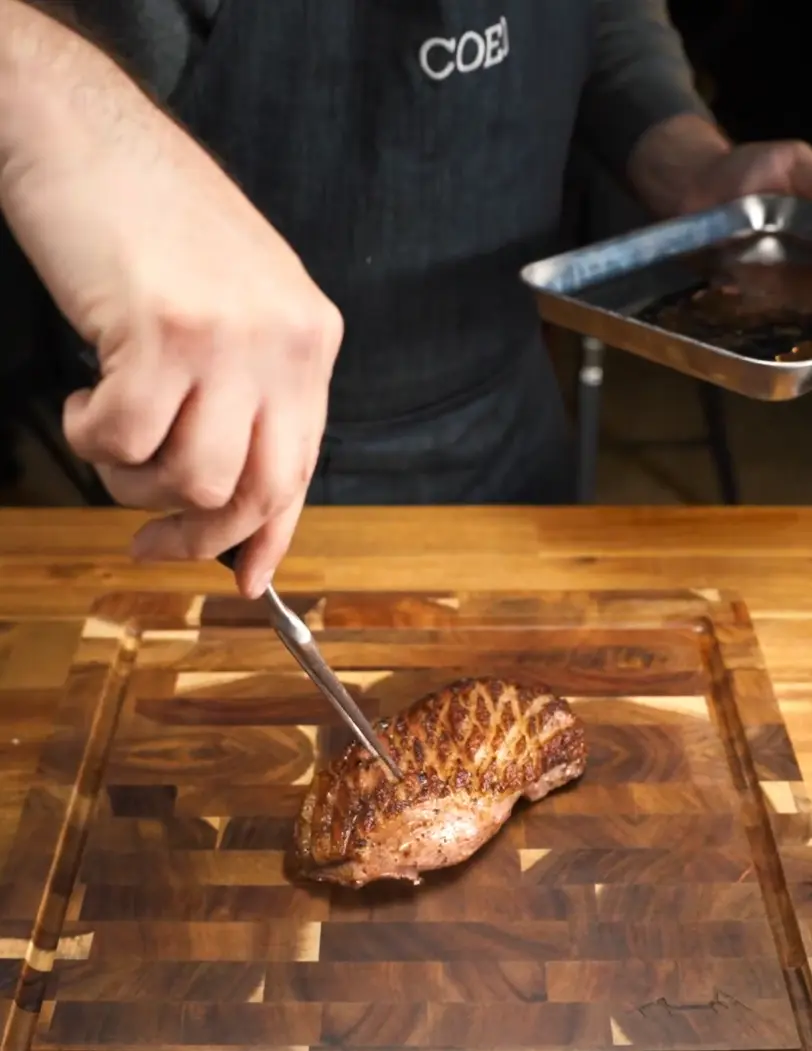
Remove the excess fat. Score with a knife. Add BBK LAB smoked salt and pepper. Place the duck breast in a cast iron pot (without preheating the pot first). Put the pot in the QUATRO kamado.
Step 3: Prepare the sauce
Garlic chopped small, honey, soy sauce, BBK LAB spices (All purpose or Sriracha), vinegar, salt.
Step 4: Cook the sauce
Remove the duck breast and set it aside. In the casserole, keep the fat from the duck breast, add the sauce and the butter. Allow to thicken.
Step 5: Cut and serve
Slice the duck breast thinly and drizzle with the sauce.
Why cook a duck breast in a kamado?
Cooking duck breast on a kamado allows for precise temperature control, essential for respecting this noble cut. The kamado provides even cooking, ideal for searing the skin side and then finishing with indirect heat. The result: a juicy duck breast, pink in the middle, with subtle aromas of wood fire.
Key questions.
At the barbecue, you can grill a wide variety of foods: meats (steaks, chicken, ribs, skewers), fish (salmon, sardines, tuna), seafood, vegetables (peppers, courgettes, corn), as well as grilling cheeses and fruits like pineapple or peach. Grilling imparts a unique smoky flavour and allows for easy variation of recipes outdoors.
To grill a rib of beef on a kamado, start by heating the device for direct cooking at high temperature. Sear the meat for 2 to 3 minutes on each side to achieve a nice crust, then install a deflector to switch to indirect cooking. Close the dome and let it cook until the desired internal temperature is reached. Thanks to its thermal stability, the kamado ensures an even, juicy, and perfectly controlled cooking process.
To get started with the kamado, focus on three simple and essential techniques:
- Direct cooking: ideal for quickly searing steaks, skewers or vegetables, with the grill placed directly above the charcoal.
- Indirect cooking: with a deflector, the heat surrounds the food, perfect for roasts, poultry or slow cooking without burning.
- Low & slow: cooking at low temperature for several hours, ideal for ribs, pulled pork or lamb shoulder.
These three methods allow you to take advantage of the thermal stability of the kamado and easily achieve consistent and tasty results.
The kamado allows you to cook all types of meat thanks to its precise temperature control. You can prepare steaks, rib-eye, ribs, whole chickens, poultry, lamb, as well as slow-cooked cuts like pulled pork or brisket. Its direct or indirect cooking ensures juicy, smoked, and perfectly seared meats, regardless of the cut chosen.
The rule of 3 is a simple principle used in barbecuing to achieve all cooking without burning the food. It involves dividing the grill into three heat zones:
-
Hot zone (direct cooking)
Ideal for quickly searing meat and achieving a nice crust. -
Medium zone (gentle cooking)
To continue cooking without charring. -
Cold zone (rest / keep warm)
Allows for gentle finishing of cooking or to set food aside.
This technique ensures controlled cooking, avoids flames, and allows for consistent results, regardless of the type of barbecue (kamado, charcoal, gas).