
In brief: to successfully make a kamado pizza, heat the stone to 350–400 °C with a deflector underneath, preheat for 45 to 60 minutes, then cook for 2 to 4 minutes with the lid closed, turning the pizza halfway through cooking. The secret lies in three points: a stone saturated with heat, a dough matured for 24 hours in the cold, and semolina (not flour) on the peel.
This guide provides the exact weights, ventilation settings, a temperature/time chart by pizza style, and solutions to the 8 most common problems. It applies to all kamados, including the QUATRO M (16 inches) and QUATRO L (21 inches) from COEO.
Summary
- Recipe sheet
- Why the QUATRO kamado makes better pizza than a kitchen oven
- Pizza dough for kamado (65% hydration)
- Set up the kamado for pizza
- Step by step cooking
- COEO equipment for kamado pizza
- Temperature and cooking time according to pizza style
- Common problems and solutions
- Toppings and variations
- FAQ: kamado pizza
Recipe sheet
Reference | Value |
|---|---|
Servings | 4 pizzas of 30 cm (dough balls of 250 g) |
Active time | 30 min |
Dough maturation | 24 to 48 h in the refrigerator (express version: 3 h) |
Preheating the kamado | 45 to 60 min |
Stone temperature | 350 to 400 °C |
Cooking | 2 to 4 min per pizza |
Difficulty | Intermediate |
Fuel | 2 to 2.5 kg of lump charcoal + 1 piece of fruit wood |
Essential equipment: a pizza stone and a deflector (a second ceramic stone or the half-moons of the Split & Mix) to the diameter of your kamado, a pizza peel and heat-resistant gloves. The details are in the section "The COEO equipment for kamado pizza".
Recommended equipment: infrared thermometer (to read the temperature of the stone, not just the dome), electric lighter for quick ignition.
Not equipped yet? For a QUATRO M, the 30 cm Ø Pizza Pack includes the stone, the perforated peel and a pair of gloves. For a QUATRO L, the 36 cm Ø Pizzas Pack is recommended. The QUATRO L comes with the Split & Mix and its deflector half-moons: the pack is sufficient. On the QUATRO M, add a second stone as a deflector or the optional Split & Mix.

Highlighted Products
Why the QUATRO kamado makes better pizza than a kitchen oven
A kamado reaches 350 to 400 °C, which is 100 to 150 °C higher than a domestic oven. At this temperature, the dough puffs up before drying: the crust becomes crispy on the outside and airy on the inside.
Three sources of heat work simultaneously. The stone cooks the bottom by conduction. The ceramic dome reflects radiant heat onto the topping. Hot air circulates from the bottom to the top by convection. Discover here how a kamado works.
Device | Max temperature | Cooking time | Typical result |
|---|---|---|---|
Domestic oven | 250–275 °C | 10–15 min | Dry dough, pale bottom |
Kamado + stone | 350–400 °C | 2–4 min | Puffed crust, slight smoke |
Neapolitan wood-fired oven | 430–480 °C | 60–90 s | Leopard spotted crust |
The inertia of the ceramic is another advantage: the stone regains its temperature in 5 to 8 minutes between two pizzas, whereas a metal barbecue loses its heat with every opening.
Pizza dough for kamado (65% hydration)
A dough hydrated at 65% and matured for 24 hours in the cold produces a lighter, more digestible, and more colourful crust than a dough risen for 2 hours. Weigh everything to the gram: in pizza, the scale matters more than the recipe.
Ingredient | Maturation 24–48 h (recommended) | Express version 3 h | % of the flour |
|---|---|---|---|
Type 00 flour (W 260–300) | 600 g | 600 g | 100 % |
Fresh water | 390 g | 390 g (warm, 25 °C) | 65 % |
Fine salt | 18 g | 18 g | 3 % |
Fresh baker's yeast | 1.5 g | 9 g | 0.25 % / 1.5 % |
Olive oil (optional) | 10 g | 10 g | 1.7 % |
If you only have dry yeast, divide the weight of fresh yeast by three.
- Dissolve the yeast in the water. Pour over 90 % of the flour and mix for 2 minutes.
- Add the salt, then the rest of the flour. Add the oil last.
- Knead for 10 minutes by hand (6 minutes in a mixer, slow speed). The dough should be smooth and pull away from the bowl.
- Let it rest for 1 h at room temperature, covered.
- Divide into 4 pieces of 250 g and shape them tightly.
- Place them in an oiled and closed box, 24 to 48 h in the refrigerator (express version: 2 h at room temperature).
- Take the pieces out 2 h before baking: a cold dough tears and bakes poorly.
How to roll out the dough
On a semolina-floured surface, push the air from the centre towards the edges with your fingertips. Never use a rolling pin: it pushes out the bubbles that will make the edge puff up in the kamado.
Set up the kamado for pizza
The correct setup is a deflector between the embers and the stone, with the stone placed as high as possible under the dome. Without a deflector, the underside burns before the topping is cooked.
- Empty the ashes from the hearth to clear the air inlets.
- Fill the hearth with pieces of charcoal up to the top of the basket (2 to 2.5 kg). Avoid briquettes, which produce more ash and burn less high.
- Light in 2 or 3 spots with the BOOSTER electric lighter (less than 60 seconds per spot, without chemicals) or natural fire starters. Never use methylated spirits or liquid fire starters: the ceramic absorbs the smell.
- Add a small log of fruit wood (apple, cherry) or beech after 10 minutes. It produces a flame that kisses the dome and a slight smoke. No softwoods.
- Install the deflector, then the grill, then the stone. Leave 1 to 2 cm of air between the deflector and the stone (spacers or small ceramic wedges). On the QUATRO L, the two half-moons of the Split & Mix, supplied as standard, serve as the deflector: place them side by side to cover the entire hearth, then the pizza stone on top.
- Close the lid, with the lower vent and chimney wide open.
- Preheat for 45 to 60 minutes. The dome thermometer reaches 350 °C in 20 minutes, but the stone takes twice as long. 30 minutes is not enough.
- Stabilise by closing the chimney three-quarters and the lower vent halfway when the dome approaches 330 °C.
Stone or dome: what temperature to read?
The lid thermometer measures the air under the dome, not the stone. Aim for the stone temperature with the infrared thermometer: 350 to 400 °C for a Neapolitan. If the stone is at 300 °C and the dome at 400 °C, wait a bit longer.
The lid seal
Felt seals do not withstand repeated cooking beyond 350 °C. Check the maximum temperature indicated in your kamado's manual. A ceramic fibre seal tolerates high temperatures.
Safety: always open in two stages
Above 300 °C, a sudden opening lets in oxygen and can cause a flare-up. Lift the lid by 5 cm, wait 3 seconds, then open fully.
Step-by-step cooking
A Neapolitan pizza cooks in 2 to 3 minutes on a stone at 380 °C. Prepare everything before baking: at this speed, there’s no time to look for the mozzarella.
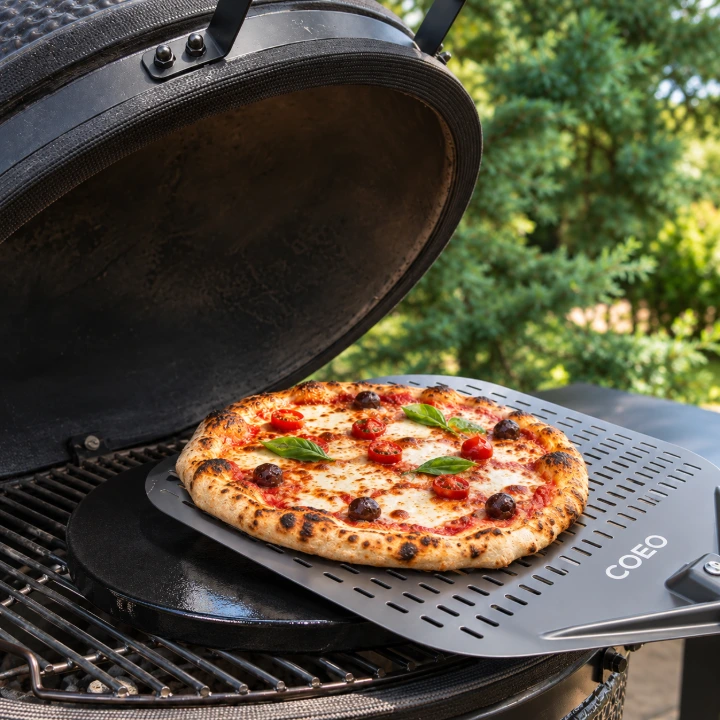
- Dust the peel with fine semolina (semola rimacinata), not flour. Flour burns at 350 °C and gives a bitter taste. A perforated peel drops the excess before baking.
- Spread the dough on the peel, then top directly on it, in less than 2 minutes. A topped dough that waits sticks.
- Shake the peel : the pizza should slide freely. If it sticks, lift the edge and slide a bit of semolina underneath.
- Bake with a swift motion : place the tip of the peel at the back of the stone and pull it out quickly towards you.
- Close the lid (opening in two stages).
- At 60–90 seconds, turn the pizza halfway. The bottom of the kamado, hinge side, is hotter.
- Take it out when the edge is puffed and speckled and the underside is golden with a few brown spots. Lift an edge with the peel to check.
- Add the raw ingredients (basil, rocket, prosciutto, burrata, drizzle of oil) at the end.
- Wait 5 to 8 minutes with the lid closed before the next pizza, to allow the stone to come back up to temperature.
A full firebox allows for 6 to 8 pizzas in succession. Beyond that, add charcoal between batches by removing the stone and deflector with gloves.
The COEO equipment for kamado pizza
A few accessories cover the entire recipe, from lighting to serving: an electric lighter, a pizza stone, a deflector, a perforated peel, and a pair of gloves.
Accessory | Role in the recipe | For which kamado | Price |
|---|---|---|---|
Light the charcoal in under 60 s, without fire starters | All | €49.90 | |
Pizza stone or deflector | Kamado QUATRO M | €25.00 | |
Pizza stone or deflector | Kamado QUATRO L | €39.90 | |
Deflector + 2 cooking levels | Standard on the QUATRO L, optional on the QUATRO M | 70.00 € or 149.00 € depending on the model | |
Bake, turn, remove | All | £59.90 | |
Handle stones, grill and hot charcoal | All | £39.00 |
The BOOSTER electric lighter
It blows heated air at 600 °C at 550 L/min and ignites the charcoal in less than 60 seconds, without gas, without flame and without chemicals. For pizza, it's a real gain: the hearth heats up across its entire surface faster, so the kamado reaches 350 °C sooner. Without fire starters or liquids, no odour passes into the ceramic or the dough. It plugs into a 230 V socket and its 22 cm aluminium tube keeps your hand away from the embers. Buy the BOOSTER lighter here on this link.
Ceramic deflector stones Ø 30 and Ø 36 cm
The same stone serves as a deflector or cooking surface. On the QUATRO M, the ideal configuration uses two: the first, placed on the support, blocks direct heat; the second receives the pizza. On the QUATRO L, the half-moons of the Split & Mix already act as a deflector: one stone is enough. They are 2 cm thick, giving them enough inertia to handle multiple pizzas. Their black enamel resists stains and moisture and is easy to clean, unlike a raw stone. Choose the Ø 30 cm for the QUATRO M kamado and the Ø 36 cm for the QUATRO L kamado. They withstand up to 500 °C, well beyond the 400 °C of a Neapolitan. Stone and perforated peel are available in a pack. Discover our deflectors (link our deflectors for kamado) for kamados, as well as our pizza stones.
The Split & Mix and its half-moon deflectors
The Split & Mix is the 2-level cooking system of the QUATRO: a stainless steel support, two half-grids in stainless steel 304L and ceramic cordierite deflectors. It is supplied as standard with the QUATRO L, with two 20 mm half-moon deflectors, and offered as an option for the QUATRO M at €70. For pizza, the deflectors cover the entire hearth and the stone is placed above. Outside of pizza, on the QUATRO L, a single half-moon allows for direct grilling on one side and indirect cooking on the other.
The perforated peel in anodised aluminium
The perforations allow excess semolina to fall before baking: fewer burnt grains on the stone, thus less bitterness. The aluminium is thinner than a wooden peel, which allows it to slide under the pizza to turn it halfway through cooking. Find the aluminium peel here (link to perforated aluminium pizza peel).
High temperature barbecue gloves
At 400 °C, a stone remains hot for over an hour. The COEO gloves made of cowhide, with reinforced palm and denim lining, protect up to 500 °C during brief contacts. Their length of 40 cm also covers the wrists and forearms, which is important when reaching under the open dome. They are used to remove the stone and deflector to reload the charcoal, to adjust the grill, and to hold the peel near the embers. Like all heat-resistant gloves, they are not made for prolonged contact with flames or embers. Find more information about our gloves and purchase them directly from our online store.
Highlighted Products
Why buy from COEO: French company from the South of France, products designed and developed in-house, customer service based in Montpellier, warranty and spare parts available. COEO products have received the iF Design Award, Red Dot and German Design Award.
Temperature and cooking time according to pizza style
The thicker and more topped the dough, the more you need to lower the temperature and extend the cooking time, otherwise the bottom burns before the centre is cooked.
Style | Stone temperature | Cooking time | Support | Cooking marker |
|---|---|---|---|---|
Neapolitan | 380–420 °C | 1 min 30–3 min | Stone | Puffed and leopard-spotted edge |
Thin and crispy Romaine | 300–330 °C | 4–6 min | Stone | Rigid, brittle bottom |
Calzone | 300 °C | 6–8 min | Stone | Golden, well-sealed closure |
New York (medium dough) | 280–300 °C | 7–10 min | Stone | Cheese bubbles and browns |
Detroit-style thick pizza | 250–260 °C | 12–15 min | Baking tray or cast iron skillet | Caramelised cheese edges |
Frozen pizza | 230–250 °C | 6–10 min | Stone | According to the packaging, while monitoring |
Focaccia | 230–250 °C | 18–25 min | Cast iron tray | Golden top, hollow sound underneath |
These times are with the lid closed. Each opening adds about 15 to 30 seconds.
Common problems and solutions
Most failed pizzas in the kamado come from a gap between the stone temperature and the dome temperature.
Symptom | Probable cause | Solution |
|---|---|---|
Burnt bottom, uncooked top | No deflector, or stone too low | Deflector + 1–2 cm of air under the stone, stone raised higher |
Cooked top, pale bottom | Stone not preheated enough | Preheat for an additional 15 min, check the stone with infrared |
Pizza sticking to the peel | Topping added too early, dough too wet | Top on the peel in less than 2 min, more semolina |
Bitter taste, black spots under the dough | Burnt flour on the stone | Replace flour with semolina, brush the stone between pizzas |
Soggy centre | Topping too abundant or too wet | Mozzarella drained for 1 hour, reduced tomato sauce, max. 150 g of topping. |
Flat edge that does not puff up | Dough rolled out or taken out too cold | Stretch with fingers, take out the dough balls 2 hours before |
Temperature drops after 3 pizzas | Exhausted charcoal or dirty firebox | Firebox full at the start, ashes emptied before lighting |
Cracked stone | Thermal shock | Stone always placed cold on cold fire, never water on a hot stone |
How to clean the stone
Let it cool in the kamado, then scrape the residues with a spatula. On an enameled stone like those from COEO, a damp sponge is sufficient afterwards. A raw stone (not enameled) is cleaned only dry, as it absorbs liquids. In all cases, never water on a hot stone.
Toppings and variations
In the kamado, a light topping cooks at the same time as the dough: aim for 80 g of sauce and 100 to 120 g of cheese per 30 cm pizza.
The bases: sauce and mozzarella
- Raw tomato sauce: peeled San Marzano tomatoes crushed by hand, salt, a drizzle of oil. No cooking: it cooks on the pizza.
- Mozzarella: fior di latte cut into cubes and drained for 1 hour in a colander. The bufala, which is wetter, is added at the end of cooking.
Four recipes that benefit from the smoke
- Margherita: sauce, fior di latte, basil and olive oil at the end.
- Bianca ricotta-zucchini: lemony ricotta cream, thin slices of zucchini, mint, parmesan.
- Smoked Diavola: sauce, mozzarella, spicy salami, pinch of chili; a cherry wood log in the fire.
- Goat-honey-nut: cream base, fresh goat cheese, walnut halves, honey drizzle and thyme at the exit.
Beyond the pizza with the same configuration: calzone, garlic flatbread, focaccia and flammekueche (5 to 6 min at 300 °C).
FAQ: kamado pizza
What temperature to cook a pizza in a kamado?
Aim for 350 to 400 °C measured on the stone for a Neapolitan pizza, 300 °C for a crispy thin crust and 250 °C for a thick pizza.
How long to cook a pizza in a kamado?
From 1 min 30 to 4 minutes at 350–400 °C, lid closed, turning the pizza halfway through cooking.
How long to preheat the kamado for a pizza?
45 to 60 minutes. The dome heats in 20 minutes, but the stone needs double that to store enough heat.
How to quickly light a kamado for a pizza?
With an electric lighter like the BOOSTER COEO, which lights the charcoal in less than 60 seconds per point. Light 2 or 3 points so that the fire takes over its entire surface, then count 45 to 60 minutes of preheating for the stone.
Is a deflector needed to make a pizza in a kamado?
Yes. Without a deflector, the stone receives direct heat from the embers and the bottom burns in less than a minute. On the QUATRO L, the half-moons of the Split & Mix supplied as standard act as a deflector. On the QUATRO M, use a second ceramic stone or the optional Split & Mix.
What size stone for my COEO kamado?
The stone Ø 30 cm (€25) for the QUATRO M kamado, the stone Ø 36 cm (€39.90) for the QUATRO L kamado.
Glazed or unglazed pizza stone: which one to choose?
A raw refractory ceramic stone absorbs moisture from the dough but also fats and stains, and is cleaned only dry. A glazed stone cooks just as well, resists stains and is cleaned with a damp sponge once cold. COEO stones are glazed and withstand up to 500 °C.
Why is my pizza sticking to the peel?
The topping has waited too long or the peel lacks semolina. Top directly on the peel in less than 2 minutes and shake it before baking.
Can you cook a frozen pizza on a kamado?
Yes, at 230–250 °C on the stone for 6 to 10 minutes. Hotter, the bottom burns before the top defrosts.
How many pizzas can you cook in a row?
6 to 8 with a full fire, allowing 5 to 8 minutes between pizzas for the stone to regain temperature.
What wood to add for a smoky flavour?
A small log of apple, cherry or beech. Never softwoods (pine, fir), which give a bitter taste.
How to clean a pizza stone?
Once cold: spatula, then damp sponge if the stone is glazed (only dry if it is raw). Never water on a hot stone, at the risk of cracking it.
Discover all the recipes and tips for cooking on a kamado
Here follow all the recipes for the kamado barbecue