The plancha brazier has established itself as one of the most appreciated outdoor cooking equipment for wood fire cooking enthusiasts. User-friendly, aesthetic, and particularly versatile, it allows for the preparation of meats, fish, vegetables, or even side dishes on a single cooking surface.
Unlike a traditional barbecue, a brazier plancha offers a major advantage: it allows for multiple temperature levels to be used simultaneously on its cooking plate. This feature transforms cooking into a much more precise and enjoyable experience. It thus becomes possible to sear a rib of beef at high temperature, continue cooking it on a more moderate area, and then keep it warm without having to constantly adjust the fire.
To fully exploit the performance of a brazier plancha barbecue, it is essential to understand how the different heat zones work and to know how to use them according to the foods being prepared.
In this comprehensive guide, discover how the three heat zones of a plancha brazier work, how to create them, and how to use them to achieve perfectly controlled cooking.
Summary
- Griddle fire pit: why do the heat zones change everything?
- How do the heat zones of a plancha grill work?
- The 3 heat zones of a plancha grill
- What temperature does a plancha brazier reach?
- How to create the 3 heat zones on a plancha grill?
- Example of cooking a complete meal on a plancha grill
- Why is moving food more effective than adjusting the fire?
- How to save wood with a plancha brazier?
- The mistakes to avoid with heat zones
- FAQ: the heat zones of a plancha brazier
PLANCHA BRAZIER: WHY DO HEAT ZONES CHANGE EVERYTHING?
The growing success of the fire pit plancha can be explained by its conviviality, its design and especially its exceptional versatility in outdoor cooking. Unlike a traditional barbecue, which often offers cooking concentrated on a grill, the fire pit plancha allows for multiple temperatures to be available simultaneously on the same cooking plate.
This feature offers a considerable advantage. You can sear a rib of beef at very high temperatures, cook vegetables over a more moderate heat, and keep food warm without constantly adjusting the intensity of the fire.
Mastering the heat zones is one of the elements that distinguishes casual users from true cooking enthusiasts with a fire pit. Once this principle is understood, your fire pit plancha becomes a true outdoor kitchen capable of adapting to all types of recipes.
HOW DO THE HEAT ZONES OF A PLANCHA BRAZIER WORK?
When a fire is lit in the brazier's hearth, the wood gradually turns into glowing embers. These embers emit a significant amount of energy that heats the cooking plate.
However, the temperature is not the same across the entire surface.
The area directly above the embers receives more thermal energy. It naturally becomes much hotter than the parts located towards the outside of the plate.
As you move away from the centre of the hearth, the heat gradually decreases.
This phenomenon creates what is called a thermal gradient. This gradient allows for multiple temperature levels on the same plate and is one of the greatest advantages of the plancha brazier.
Rather than seeking uniform heat, it is therefore wiser to exploit these variations to create different cooking zones.
THE 3 HEAT ZONES OF A PLANCHA BRAZIER
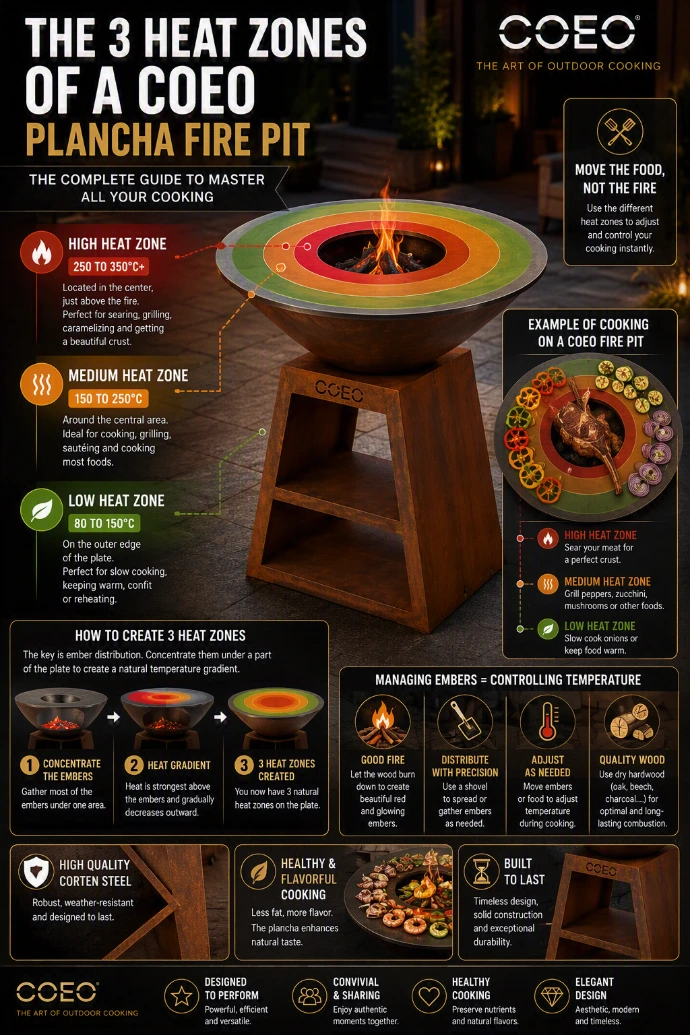
A fire pit plancha when used correctly generally allows for the distinction of three main thermal zones.
The first is for quick cooking and searing. The second is the main cooking zone. The third is reserved for gentle cooking and keeping warm.
THE STRONG HEAT ZONE: SEAR AND CARAMELISE
The strong heat zone is generally located in the centre of the plate or directly above the main concentration of embers.
This is the part that reaches the highest temperatures. Depending on the model of the plancha grill, the thickness of the plate, and the amount of wood used, it can exceed 300 °C.
This intense temperature is ideal for all cooking that requires a quick reaction on the surface of the food.
A rib of beef, a steak, a rib-eye, a duck breast, prawns or skewers will fully benefit from this significant heat. The surface of the food colours quickly and develops particularly sought-after grilled aromas.
This searing phase allows for the creation of a tasty crust while keeping the inside moist.
The most common mistake is to leave the meat on this zone for its entire cooking time. In reality, this part of the plate is mainly used to start the cooking. Once the colour is achieved, it is better to move the food to a cooler area to finish cooking more gradually.
THE MEDIUM HEAT ZONE: THE HEART OF COOKING
Between the centre and the periphery of the plate is an intermediate zone that is particularly versatile.
This part generally reaches temperatures between 150 and 250 °C. It offers the ideal balance between power and control.
Grilled vegetables, mushrooms, peppers, courgettes, aubergines, and even fish find their perfect place in this zone.
After being seared in the centre, meat can also finish cooking here gently without the risk of burning.
This zone is often the most used cooking space on a daily basis. It allows for the preparation of a wide variety of foods while maintaining excellent control over temperatures.
During a meal with family or friends, it is generally this part of the plate that accommodates the majority of the preparations.
THE GENTLE HEAT ZONE: SLOW COOKING AND KEEPING WARM
The periphery of the plate receives less direct heat. It naturally becomes the gentlest zone of the plancha grill.
The temperature there generally fluctuates between 80 and 150 °C.
This zone is perfect for foods that require more time or delicacy.
Onions can slowly caramelise there until they become melting. Vegetables can finish cooking without the risk of burning. Cheese can gradually melt and already cooked foods can stay at temperature before being served.
This part of the plate is also very useful for letting meat rest after cooking. This resting time allows the juices to distribute evenly throughout the meat and significantly improves the final result.
WHAT TEMPERATURE DOES A PLANCHA GRILL REACH?
The actual temperature depends on many parameters.
The type of wood used, the amount of embers produced, the thickness of the plate, the diameter of the grill, and even the weather conditions directly influence cooking performance.
As a general rule:
- The gentle zone is between 80 and 150 °C.
- The medium zone is between 150 and 250 °C.
- The strong zone can reach 250 to 350 °C, or even more on some high-end models.
These temperature variations allow for the simultaneous management of several types of preparations without the need for multiple cooking devices.
HOW TO CREATE THE 3 HEAT ZONES ON A PLANCHA BRAZIER?
The creation of the different zones mainly relies on the management of the embers.
When the embers are evenly distributed under the entire plate, the heat becomes relatively homogeneous. This configuration can be useful in some cases but greatly limits the possibilities offered by the brazier.
To create a true thermal organisation, it is advisable to concentrate the embers more under a part of the plate.
The temperature will then be maximum above this concentration of embers and will gradually decrease towards the more distant areas.
This method allows for the natural achievement of the three desired heat levels.
With a bit of experience, it becomes very easy to adapt this distribution according to the meal being prepared.
EXAMPLE OF COOKING A COMPLETE MEAL ON A PLANCHA BRAZIER
Let’s imagine a meal consisting of a rib of beef, grilled peppers, and melting onions.
The rib of beef is first placed in the hot zone to achieve a perfectly golden crust. Once the colour is obtained, it is moved to the intermediate zone to continue cooking.
The peppers are placed in the medium zone where they grill slowly while retaining their texture.
The onions find their place on the periphery of the plate. They cook gently until they become melting and slightly caramelised.
This organisation allows for the simultaneous preparation of a complete meal while respecting the specific needs of each food.

Categories
WHY IS MOVING FOOD MORE EFFECTIVE THAN ADJUSTING THE FIRE?
Wood fire has a certain inertia. Modifying its power takes time.
Conversely, moving a food item from one area to another is done instantly.
This simplicity is one of the greatest assets of the plancha grill.
Rather than trying to constantly adjust the heat source, it is enough to move the food according to its cooking level.
The high zone allows for searing. The medium zone allows for cooking. The low zone allows for finishing cooking or keeping warm.
This approach significantly facilitates the management of meals involving several simultaneous preparations.
HOW TO SAVE WOOD WITH A PLANCHA FIRE PIT?
One of the most common mistakes is to want to heat the entire plate at full power.
For daily use or for cooking for a few people, it is often more efficient to concentrate the embers on a limited part of the heat source.
This method reduces wood consumption while providing excellent cooking quality.
It also allows for a faster temperature rise and better thermal control.
Good management of the embers is often much more effective than a constant increase in the amount of fuel.
MISTAKES TO AVOID WITH HEAT ZONES
Many users spread the embers evenly under the entire plate, thus eliminating the temperature differences that make the grill interesting.
Another mistake is to leave meat on the hottest area for the entire cooking time. This method risks drying out the food and degrading its taste quality.
It is also advisable to avoid overcrowding the plate. Sufficient space between the foods allows for better management of the different temperatures and facilitates movement during cooking.
Finally, one should not believe that a more powerful fire automatically guarantees a better result. Mastery of the embers is much more important than their quantity.
FAQ: THE HEAT ZONES OF A PLANCHA FIRE PIT
HOW MANY HEAT ZONES CAN BE CREATED ON A PLANCHA BRAZIER?
It is possible to create several temperature levels. However, three distinct zones are the simplest and most effective reference for comfortable cooking.
WHERE TO SEAR MEAT ON A PLANCHA BRAZIER?
The meat should be placed on the hottest part of the plate to quickly develop a nice colour before finishing its cooking on a more moderate area.
WHERE TO COOK VEGETABLES?
Vegetables are generally more comfortable in the intermediate zone, which allows them to cook gradually while retaining their texture.
CAN FOOD BE KEPT WARM?
Yes. The periphery of the plate is an excellent space to keep food at temperature before serving.
HOW TO KNOW WHICH IS THE HOTTEST ZONE?
The part located directly above the main concentration of embers is usually the hottest. An infrared thermometer can accurately measure the temperature of each zone.
WHAT IS THE ADVANTAGE OF A PLANCHA BRAZIER COMPARED TO A CLASSIC BARBECUE?
The plancha brazier allows for simultaneous cooking of different foods at various temperatures while providing a more versatile and user-friendly cooking surface.
CONCLUSION
Mastering the three heat zones of a plancha brazier is one of the best ways to immediately improve the quality of your wood-fired cooking.
The strong zone allows for perfect searing, the intermediate zone ensures controlled cooking, and the gentle zone facilitates finishing touches as well as keeping food warm.
By understanding how to distribute the embers and how to intelligently use each part of the plate, you transform your plancha brazier into a true professional outdoor kitchen.
This method improves cooking precision, reduces wood consumption, and allows for easily preparing a complete meal for the whole family or for many guests. It simply represents one of the secrets behind the success of the modern plancha brazier.
Categories
THE 3 HEAT ZONES OF A GRIDDLE FIRE PIT AT A GLANCE
| HEAT ZONE OF THE GRIDDLE FIRE PIT | TEMPERATURE | COOKING TYPE | FOOD EXAMPLES |
|---|---|---|---|
| HIGH ZONE | 250 TO 350°C | QUICK SEAR AND CARAMELISATION | RIB EYE, STEAK, DUCK BREAST, PRAWNS, SKEWERS |
| MEDIUM ZONE | 150 TO 250°C | CONTROLLED COOKING | FISH, VEGETABLES, POULTRY, SAUSAGES |
| LOW ZONE | 80 TO 150°C | SLOW COOKING AND KEEPING WARM | CONFIT ONIONS, MELTING VEGETABLES, CHEESE, PRE-COOKED FOODS |
The 3 heat zones of a COEO plancha brazier allow for searing, cooking, and keeping food warm on a single cooking plate.
English version - Understanding the heat zones of a COEO plancha brazier is essential for mastering cooking and saving wood.